Documentary vs Traditional Wedding Photography: What’s the Difference?
TL;DR: Documentary wedding photography captures unposed moments as they happen. Traditional wedding photography poses and directs everyone for ideal compositions. Most modern weddings combine both, but each photographer leans heavily one way. This guide explains what each style actually looks like, when each works best, what each costs, and how to figure out which is right for your wedding. Written by a documentary wedding photographer who’s photographed both styles for 15+ years and refers couples to traditional photographers when that’s what they actually want.
This is one of the questions I’m asked most often by couples first researching wedding photography: “What’s the difference between documentary and traditional wedding photography? Which one should I want?”
There’s no universally correct answer. Both styles produce beautiful weddings. They produce different kinds of beautiful, and the right choice depends entirely on what you’ll value when you look back on the day.
I’m a documentary wedding photographer based in Porto. I’m declaring that bias up front. But I work alongside excellent traditional photographers, refer couples to them when their priorities clearly fit, and have shot enough of both styles to give an honest comparison. Here’s what each actually looks like.
What documentary wedding photography actually is
Documentary wedding photography (sometimes called photojournalistic, reportage, or candid wedding photography) is the practice of photographing the wedding day as a journalist would cover any event — observing without intervening, capturing moments as they happen, prioritizing emotional truth over composed perfection.
In practice, this means:
- Minimal posing. The photographer doesn’t tell you where to stand, what to do, or how to look. Family group shots are usually the only directed moments.
- Lots of long lenses. Documentary photographers shoot from a distance to avoid affecting the moments. Less than half their gear is wide-angle.
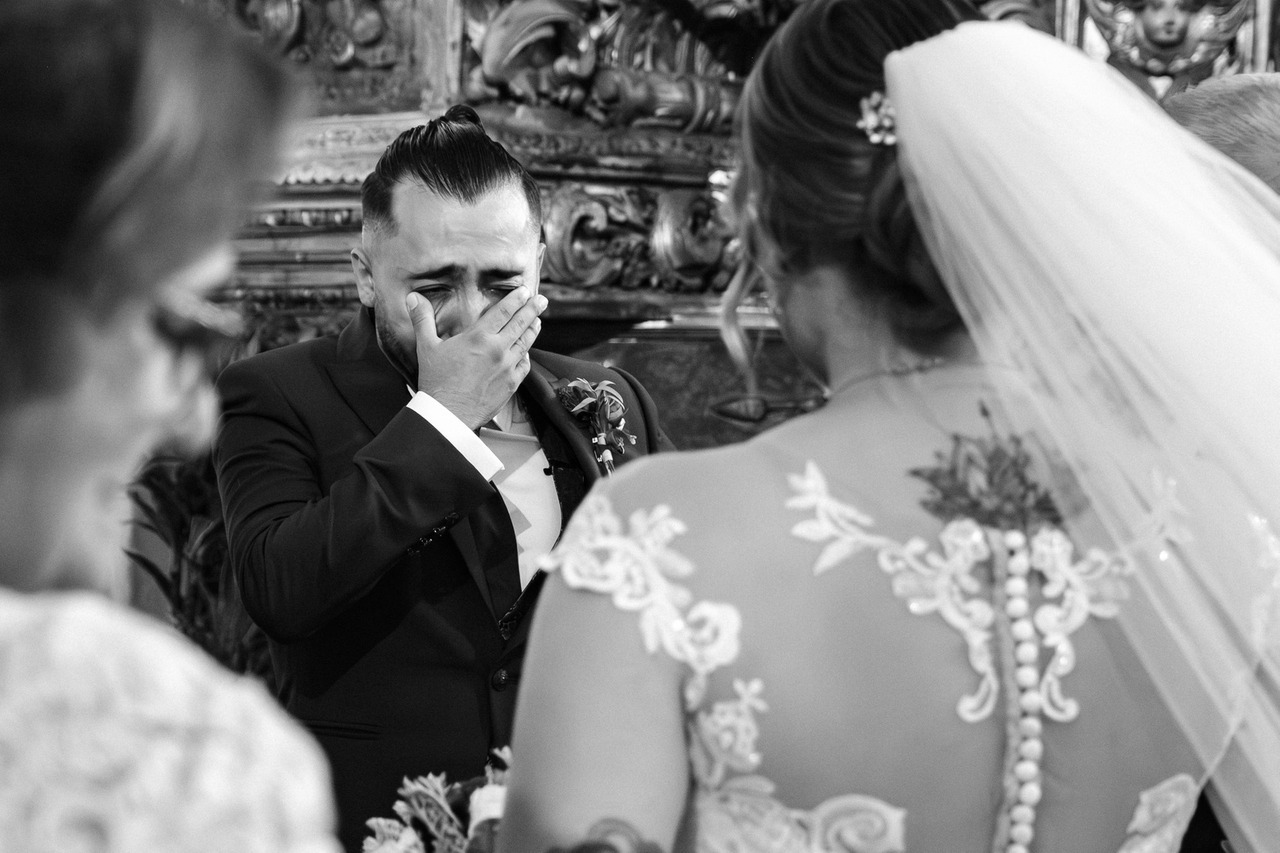
- Coverage of the in-between. The hour after the ceremony when guests are mingling. The moment your father wipes his eyes during your speech. The grandfather sneaking a slice of cake before dinner is served.
- Imperfect compositions. A guest’s arm in the corner of frame. The unplanned bird flying past. The light slightly wrong. These don’t get cropped out — they’re part of the story.
- Post-production that preserves reality. Color correction, exposure adjustment, slight cleanup. Not skin smoothing, sky replacement, or face swapping.
The result is a wedding gallery that looks like it actually happened — with all the chaotic, beautiful, imperfect texture of a real day, not a styled magazine shoot.
What traditional wedding photography actually is
Traditional wedding photography (sometimes called classic or formal wedding photography) is the older approach — the one your parents and grandparents would recognize. The photographer directs the day’s images, posing the couple, the bridal party, the family, and often the guests, to produce composed, flattering, technically clean photographs.
In practice, this means:
- Posed family and group shots. Often 30-40+ formal group combinations.
- Directed couple portraits. Specific poses, locations, and expressions chosen by the photographer.
- Strong attention to flattering angles. Body positioning, chin angles, hand placement.
- Controlled lighting. Off-camera flash to fill shadows. Reflectors. Sometimes assistants holding lights.
- Polished post-production. Skin smoothing, sometimes background cleanup, color and tone matched to a specific aesthetic (warm-and-airy, dark-and-moody, vintage-film, etc.).
The result is a wedding gallery where everyone looks their best, every composition is intentional, and the couple is unmistakably the centerpiece of every image.
A side-by-side scenario
Imagine the same moment shot two ways:
The bride is walking down the aisle. Her father is beside her. Her grandmother, sitting in the front row, has just started crying.
A documentary photographer is positioned 20 meters back with a long lens, watching for grandmother. They take 4-5 frames as her face shifts from controlled to overwhelmed. Bride and father are partially visible in the foreground; grandmother’s face is sharp. The frame is tight on her hands clasped against her chest.
A traditional photographer is centered in the aisle, instructed the bride to walk slowly, and is taking carefully composed frames of her with the father. The grandmother’s tears are background. Later, after the ceremony, this photographer will pose the bride with her grandmother for a portrait.
Both produce beautiful images. Different beautiful. The documentary frame is what was actually happening. The traditional frame is what your bridal portrait should look like. Couples differ on which they value more.
Which fits your wedding (a working framework)
Documentary fits if:
- You feel awkward in front of the camera
- You hate posed family-photo days at every prior family event
- Your wedding has 50+ guests and you care about all of them
- You value emotional truth over physical perfection
- Your style preferences lean toward “I want to remember the day” rather than “I want a perfect album”
- You’re okay with some images being imperfect compositionally if they capture something real
- Your priority quote is: “I want photos of what actually happened, not what we wanted it to look like.”
Traditional fits if:
- You’re comfortable with posing and have done modeling, dance, or theater
- You want every image to be flattering and well-composed
- Your wedding is intimate (under 30 guests) where formal portraits make more sense
- You want a printed album that looks like a magazine
- Your family expects formal portraits and group photos
- Your priority quote is: “I want this day to look its best, period.”
Hybrid (most photographers offer some version) fits if:
- You want documentary coverage of the day but specific posed portraits afterward
- Family or in-laws strongly want formal group shots
- You want both your guests’ real expressions and a few editorial portraits
- You’re okay with the photographer dividing their attention between observing and directing
Most foreign couples I work with end up with documentary-leaning hybrid: 80% unposed coverage, 20% directed (family group shots, a 15-minute portrait session at golden hour). This is the most common request and works well for most modern weddings.
What each style costs
Documentary photography is priced similarly to traditional at the same experience tier. Specific ranges in my photographer choosing guide — but quickly:
- Mid-range Portuguese photographers: €1,500-€2,800 (either style)
- Established documentary or traditional specialists: €2,800-€4,500
- Top-tier (either style): €4,500-€8,000+
Within these tiers, documentary photographers and traditional photographers compete on quality and connection, not price. There’s no inherent cost difference.
A small note: photographers who do both styles equally well are rare. Most lean strongly one way. If you want truly excellent traditional portraits and documentary coverage, you may need to:
- Book a documentary photographer for the day, with a 30-minute portrait session by a stylist or family-portrait specialist
- Or book a traditional photographer for the morning + ceremony + family portraits, with a documentary photographer for the reception
The latter is rare in Portugal and adds complexity. Most couples simplify by choosing one and accepting the trade-off.
How to tell which style a photographer leans toward (without asking)
Look at their full galleries with these questions in mind:
Documentary indicators:
- Many photos of guests, not just the couple
- Many photos taken from across rooms, with people unaware
- Real expressions: genuine laughter, tears, concentration
- Some compositional “imperfections” preserved
- The couple is photographed in everyday positions (sitting at dinner, walking, talking)
- The bridal party and family look like themselves, not models
Traditional indicators:
- Most photos feature the couple in posed positions
- Backgrounds are clean and curated
- Expressions are uniform across guests (mostly smiling at camera)
- Post-production is heavily stylized (specific color palette, mood)
- Flash is visibly used in many indoor shots
- The album shows fewer guests prominently
Most photographers’ websites display their best work, which makes the lean clearer than full galleries do. But ask to see a full gallery if you want truth.
What to expect from a documentary photographer on your wedding day
If you book documentary, this is what your day looks like:
- The photographer arrives early during preparation and observes quietly. They might suggest you spend 30 minutes with your partner before the camera “officially starts” — for documentary couples, this morning private time often produces the best images of the day.
- They don’t direct the ceremony. They position themselves to catch the most emotional angles. They won’t tell guests where to look.
- Family group shots are still happening. Documentary photographers do family portraits, but typically faster and with less direction than traditional photographers. 20-30 minutes is the standard, vs 45-60 minutes for traditional.
- They disappear during the reception. You’ll see them but they won’t be visible. This is the time their long lens earns its weight — they’re capturing toasts, dancing, quiet table conversations from across the room.
- They stay until late. Documentary coverage often runs 10-12 hours because the late dancing/closing moments are when emotions peak. This is intentional and increases costs.
What to expect from a traditional photographer on your wedding day
If you book traditional, this is what your day looks like:
- They arrive at preparation and direct. Where to stand, how to hold the bouquet, where the dress should drape.
- The ceremony is shot from specific positions for specific shots. Some traditional photographers ask the couple to slow down or repeat the kiss for the camera.
- Family portraits take 45-60 minutes. A list is collected in advance. The photographer directs everyone’s positions. Repeats until composition is perfect.
- Reception coverage is more controlled. The photographer often stops the dancing for posed group shots. Cuts the cake on cue. Photographs the toast preparation.
- They typically leave earlier. Traditional photographers often book 8-10 hour packages because the highlight images are completed by mid-evening.
Both work. Different weddings. Different photos. Different experiences.
A note about social media and Pinterest expectations
Foreign couples often arrive at planning with Pinterest boards full of editorial wedding images. These are usually traditional or fine-art editorial photography — the wedding equivalent of fashion magazine covers.
If your Pinterest board is full of these images, three things are true:
- Most of those images are stylized for publication. Real weddings don’t look like Pinterest, even when shot by the same photographers. The bride and groom on a vintage motorcycle in a wheat field at sunset wasn’t a candid moment.
- Trying to recreate Pinterest images requires direction and time on your wedding day. If you want a specific styled portrait, build 30-60 minutes into your timeline. Documentary photographers can do styled portraits but it’s not their default mode.
- Pinterest expectations sometimes lead to disappointment with documentary coverage. Documentary photographers will give you something different (and arguably more valuable in the long run), but it won’t look exactly like your saved images.
If you’re heavily Pinterest-influenced, consider whether your dominant preference is actually editorial/traditional. There’s nothing wrong with that — but match your photographer choice to your actual taste, not to a style you assume “everyone wants.”
What I tell couples who ask which style is right for them
A short script:
Look at five complete wedding galleries from each style. Notice which one makes you feel something about the people in it. Notice which one makes you cry, laugh, or pause. That’s your answer.
It’s not about which is “better.” It’s about what you’ll value. Both styles are practiced at the highest level by photographers in Portugal. The right choice for you is whichever creates images that matter to you specifically.
For me — and I’ll declare the bias openly — documentary photography fits the way I want to see my own family’s weddings. I want to see what people felt, not what they posed for. But I have friends and colleagues whose work in traditional and editorial wedding photography is extraordinary, and for couples whose priorities align with that, those photographers are the right choice.
Frequently Asked Questions
Can I have both styles in one wedding?
Yes, with caveats. Most documentary photographers will do 30-40 minutes of posed portraits and family group shots. Most traditional photographers will let candid moments through. But trying to get equal coverage of both styles usually means hiring two photographers, which costs roughly 1.5x the single-photographer rate.
Which style is better for international guests / multi-cultural weddings?
Documentary, in my experience. Cultural traditions photograph better when they’re not interrupted for posing. The bride’s father’s traditional dance, the grandmother’s blessing, the spontaneous toast in a different language — these are the moments documentary photography captures best.
Which style is better for my Pinterest-style aesthetic preferences?
Traditional or editorial. If you want your wedding to look like a styled magazine shoot, you need a photographer who shoots that way. Documentary photographers can produce some images in that style but it’s not their primary work.
How do I know if a documentary photographer is good?
Look for: emotional range across many subjects (not just the couple), strong technical work in difficult lighting, consistent style across the gallery, and the ability to tell a story with sequences rather than isolated images.
How do I know if a traditional photographer is good?
Look for: clean compositions, flattering angles for varying body types, consistent post-production style, attention to detail in poses, and good handling of group shots (especially the difficult ones — large families, mixed heights, varying ages).
What about “fine art” or “editorial” wedding photography?
This is a third style that overlaps with traditional but pushes further toward fashion and styling. Heavy direction, intentional aesthetic, often shot on film. Best for couples who genuinely love that look and have the patience for the longer setup times required. Significantly higher price tier in most cases.
Will my photos look outdated in 20 years?
Documentary tends to age better because it relies less on contemporary aesthetic trends. Traditional ages in waves — every decade has its dominant style. Editorial/fine art ages fastest because it’s most tied to current fashion. This is a generalization; individual photographers’ work varies.
Should I tell my photographer my style preference upfront?
Yes. Photographers are usually clear about which style they shoot. If you tell a documentary photographer you want fine art editorial, they’ll either decline (the honest ones) or take the work and disappoint you (the dishonest ones). Be clear early; it benefits both parties.
Where to go from here
If you’re choosing your wedding photographer style now, the practical sequence:
- Look at five complete wedding galleries from each style on photographers’ websites
- Notice which makes you feel emotion (any emotion)
- That’s your dominant style preference
- Use the photographer choosing guide for the framework on selecting specific photographers
- For the broader wedding planning, see the getting married in Porto master guide
If documentary photography is what you’re drawn to and you’re considering Porto for your wedding: contact me. I respond personally to every email. I’ll happily talk through whether my approach matches what you want, and refer you to colleagues if it doesn’t.
The right style for your wedding is the one that produces images you’ll still feel something about in twenty years. Both documentary and traditional can do that. The choice is yours to make based on what kind of memory you want to keep.